Fourier analysis of an oscillatory or chirp signal assumes time-translation invariance: the material must not change while it is being measured. When the microstructure evolves on a timescale comparable to the measurement (curing, gelation, ageing), this assumption breaks down and the spectrum is distorted. The mutation number quantifies the effect by comparing the measurement window with the characteristic time of change of the material (Mours and Winter, 1994).
For a representative viscoelastic quantity (here ; or also work), the mutation time is
and the mutation number over a measurement of duration is
Jamali and McKinley (2022) discuss as a limiting case of the Mnemosyne number for materials with memory.
For successive OWChirp waves of duration recorded at times , the derivative is estimated by a finite difference at each angular frequency :
The logarithmic derivative makes independent of the modulus scale. A small means the sample is effectively static during a wave, so the spectrum is reliable; the usual criterion is . Perego et al. (2025) use it to choose the OWChirp duration for time-resolved measurements: a shorter chirp lowers but also narrows the accessible frequency window through the time–bandwidth product (Tutorial 2).
import warnings
from pathlib import Path

from hermes_rheo import read_file
from hermes_rheo.file_readers.trios_rheo_txt import TriosRheoReader
from hermes_rheo.transforms.mutation_number import MutationNumber
from hermes_rheo.transforms.owchirp_analysis import OWChirpAnalysis
from hermes_rheo.visualization import use_science_style

use_science_style()
warnings.filterwarnings("ignore")  # scikit-learn / SciPy convergence notices
DATA = Path("tutorial_data")
experiment = read_file(DATA / "aresg2_trios_owchirp_time_sweep.txt",
file_reader=TriosRheoReader, create_composite_datasets=True)
mutation = (OWChirpAnalysis() + MutationNumber(dependent_variable="complex modulus"))(experiment)
fig, axes = mutation.visualize(show_all_frequencies=True, y_lim=(0, 0.5))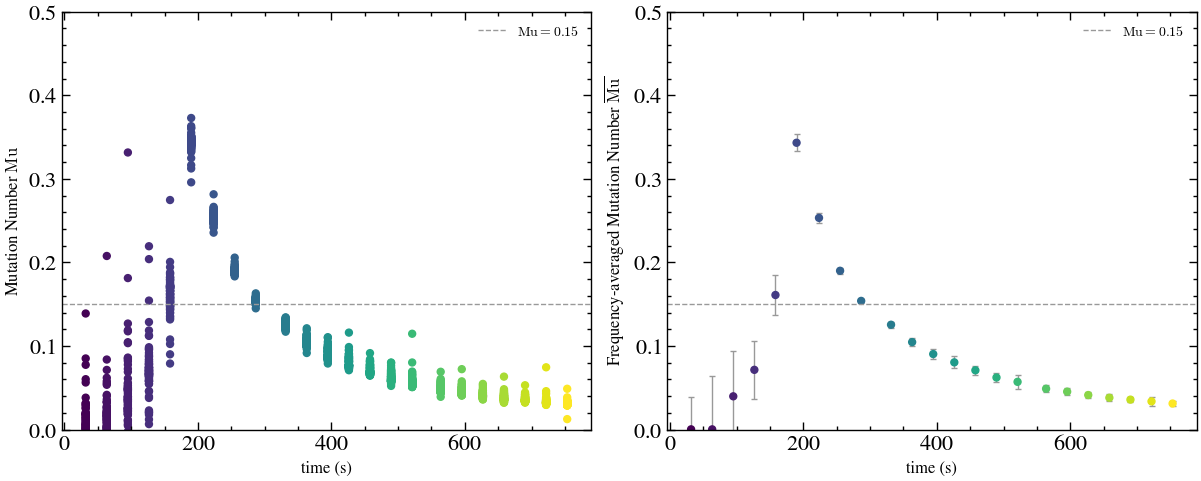
Left: at every frequency against cure time. Right: mean and standard
deviation over frequency at each time. Spectra with change
appreciably within one wave and should be interpreted with care. The mean and maximum per frequency
are stored in the details of each measurement.
The OWChirp data were decimated by a factor of 4 (500 Hz → 125 Hz, every 4th point kept) to reduce file size; the full-resolution files are available on request from Alessandro Perego (aperego@mmm.com).
Mutation number during a temperature ramp (TORCh)
In the curing example the material mutates on its own chemical clock. In a Thermally Optimised Ramped Chirp (TORCh) experiment (Vadillo et al., 2026), OWChirps are applied continuously during a temperature ramp, so the mutation is imposed by the operator through the ramp rate . If the viscoelastic properties are single-valued functions of temperature, the chain rule separates the temperature dependence of the material from the imposed ramp:
The absolute value covers both stiffening and softening; on heating decreases and Mu is negative. The ramp rate and chirp duration must keep , most critically near thermal transitions such as the glass transition, where changes steeply with . The frequency-averaged value is a useful summary because the apparent mutation time varies little across one chirp.
Thermal gradients. The sample must also follow the plate temperature. Time-translation invariance then requires the heat-diffusion time through the gap to be short compared with the mutation time:
with density , specific heat capacity and thermal conductivity . For a 1 mm polymer specimen ( kg/m³, J/(kg K), W/(m K)), s, so requires s.
The data below are a TORCh ramp from −50 to 25 °C and from 25 to 150 °C at
3 °C/min with 10 s chirps. The file already contains and of every
chirp, computed by TRIOS, so no OWChirpAnalysis step is needed.
absolute=True returns , dt_threshold skips the
pair of chirps that straddles the isothermal dwell between the two ramps, and
color_by="temperature" colours each point by the chirp temperature.
torch = read_file(DATA / "dhr30_trios_torch.txt",
                  file_reader=TriosRheoReader, create_composite_datasets=True)

torch_mutation = MutationNumber(owch_length=10, absolute=True, dt_threshold=50)(torch)
fig, axes = torch_mutation.visualize(show_all_frequencies=True,
                                     color_by="temperature", cmap="coolwarm")

mu_max = max(m.details["mutation_number_max"] for m in torch_mutation.measurements)
print(f"max |Mu| = {mu_max:.3f}  ->  shortest mutation time = {10 / mu_max:.0f} s")
max |Mu| = 0.104 -> shortest mutation time = 96 s
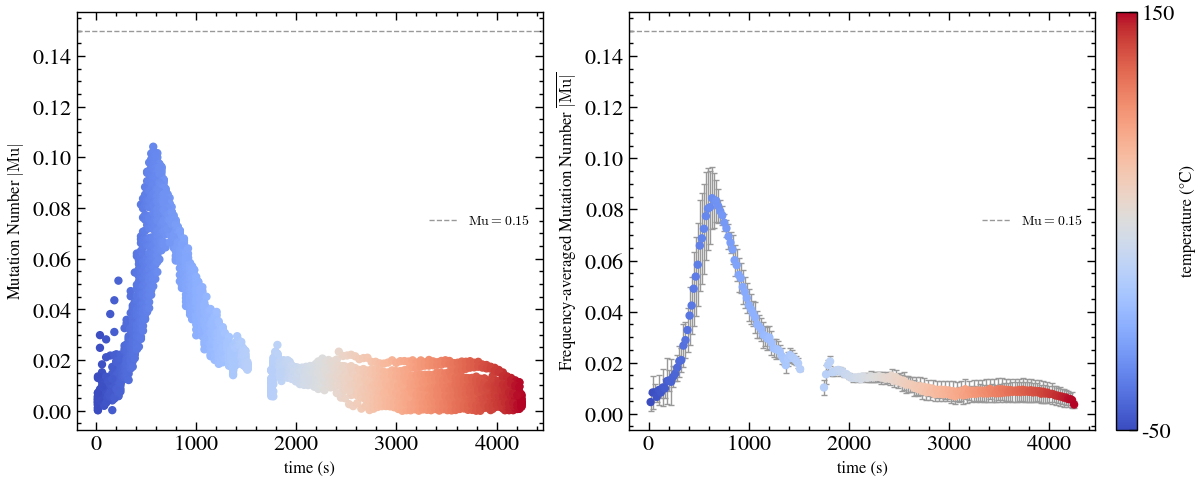
peaks at about 0.1 as the sample passes through the glass transition (around −20 °C) and drops to about 0.01 in the rubbery region of the second ramp. It stays below 0.15 at all frequencies, so every chirp is quasi-static. The shortest mutation time is about 100 s, so and thermal gradients are also negligible. Tutorial 9 maps over temperature and frequency.
References
Mours, M. and Winter, H. H., Time-resolved rheometry, Rheologica Acta 33, 385–397 (1994). DOI: Mours & Winter (1994).
Jamali, S. and McKinley, G. H., The Mnemosyne number and the rheology of remembrance, Journal of Rheology 66, 1027–1039 (2022). DOI: Jamali & McKinley (2022).
Perego, A., Vadillo, D. C., Mills, M. J. L., Das, M. and McKinley, G. H., Evaluation of Optimally Windowed Chirp Signals in Industrial Rheological Measurements: Method Development and Data Processing, Rheologica Acta 64, 391–406 (2025). DOI: Perego et al. (2025).
Vadillo, D. C., Perego, A. et al., TORCh: Thermally Optimised Ramped Chirp for time-temperature spectroscopy of polymers, Macromolecules (2026). DOI: Vadillo et al. (2026).
- Mours, M., & Winter, H. H. (1994). Time-resolved rheometry. Rheologica Acta, 33(5), 385–397. 10.1007/bf00366581
- Jamali, S., & McKinley, G. H. (2022). The Mnemosyne number and the rheology of remembrance. Journal of Rheology, 66(5), 1027–1039. 10.1122/8.0000432
- Perego, A., Vadillo, D. C., Mills, M. J. L., Das, M., & McKinley FRS, G. H. (2025). Evaluation of optimally windowed chirp signals in industrial rheological measurements: method development and data processing. Rheologica Acta, 64(8), 391–406. 10.1007/s00397-025-01511-0
- Vadillo, D. C., Perego, A., Whitcomb, K., Behling, R. E., Gill, A. M., Das, M., & McKinley FRS, G. H. (2026). TORCh: Thermally Optimized Ramped Chirps for the Efficient Generation of Rheological Master Curves. Macromolecules, 59(12), 6893–6905. 10.1021/acs.macromol.6c00679